 Forklifts move the goods that keep New York's warehouses, distribution centers, and construction sites running. They're also among the most dangerous machines on any worksite, which is exactly why training and certification aren't optional.
If you're a worker looking to operate a forklift, or an employer responsible for a crew, here's everything you need to know about getting "licensed" to drive one in the Empire State.
Does a Forklift License Required by the State of New York?
Here's the first thing to clear up: New York does not issue a forklift "license" the way the DMV issues a driver's license. There's no state agency that hands you a forklift card after a road test. Instead, the requirement is federal, set by the Occupational Safety and Health Administration (OSHA).
So when people say "forklift license" in New York, what they really mean is OSHA certification. To legally operate a forklift, you must complete OSHA-compliant training and be certified by your employer as competent to run the specific equipment you'll be using.
That certification applies everywhere in the state, from Buffalo to Brooklyn, and it's mandatory for anyone operating a powered industrial truck in the private sector.
I’ve talked to many employers and operators, and they often use ‘forklift’ and ‘forklift certification’ interchangeably. So now it’s clear.
Are There Specific Requirements NY Has When Certifying Forklift Operators?
Recently, I was approached by one of our crew, he is planning to settle in New York for good, and asked me if he could be an operator there. One thing for sure, he can.
Because forklift rules come from OSHA rather than from Albany, the requirements in New York are the same federal standards that apply nationwide. There is no separate New York-only curriculum or state exam layered on top.
That said, there is one jurisdictional detail worth knowing: federal OSHA covers private-sector workers located within the state. Workers employed directly by state and local government agencies are not covered by federal OSHA in the same way. For the vast majority of New York forklift operators, though, the OSHA requirements apply directly and in full.
It's also worth dismissing a common myth: small operations are not exempt. Some business owners assume that running only one or two lifts means they don't need certified operators. That's false, and New York employers face some of the steepest fines in the country for forklift violations.
What OSHA Rule Does NY Follow?
The governing regulation is OSHA Standard 29 CFR 1910.178, specifically subsection (l), which deals with operator training. This is the rule every legitimate training provider in New York builds its program around.
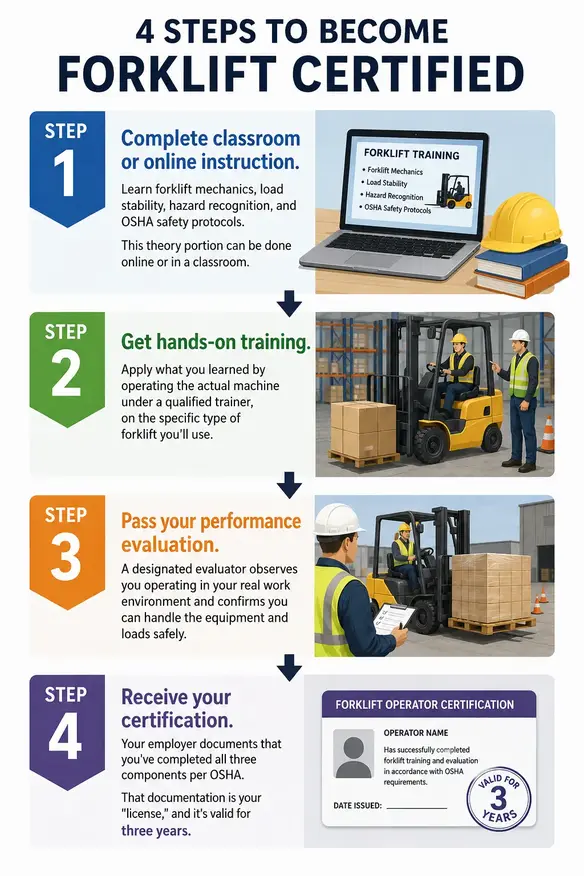
In plain terms, 1910.178 requires that every forklift operator be trained and evaluated before they're allowed to operate the equipment. It breaks training into three mandatory parts:
- Formal instruction — the classroom or theory portion (lecture, video, interactive online learning, or written material). I came across this question: Can trainees be trained without training materials, only by showing the forklifts and giving explanations? Well, of course—this is part of interactive training. Interactive doesn’t have to happen on a computer; it means there is a two-way conversation.
- Practical, hands-on training — actually operating the machine under supervision. A coworker once made a confession to me. He said he was taught how to drive a forklift by a coworker at his previous company, and the company didn’t bother checking whether that hands-on training was officially credited or not. If you ask me, it wasn’t. But he eventually got formally trained anyway.
- Performance evaluation — a qualified evaluator watches the operator handle the forklift in the real work environment and confirms competence. You know what makes trainees fail the evaluation? This is how I assess it: if a trainee knocks over three cones during maneuvering, there is a high chance they will do the same in actual work, and we cannot let that happen. One wrong move, and the stack could collapse when bumped. The operator does not always have to be attended by a spotter, which is why it is important not to bump the forklift into any structure nearby during operation.
All three are required. The rule also makes the employer ultimately responsible for ensuring an operator is competent, and for keeping training records that can be requested during an OSHA inspection.
How to Get Your Forklift License in New York
Getting certified follows a logical, four-step path — think of it like earning a driver's license: study the rules, practice with an instructor, then prove you can do it safely.
Do I Have to Take a Test in Order to Get My License?
Yes — but it's manageable. There's a written test covering the theory portion, and a practical evaluation covering your hands-on driving skills. You cannot complete one without the other — and you cannot get licensed without both.
The written exam is straightforward. When I administer the written test to my students, the questionnaire is usually comprised of the following: 50% explanation, 25% multiple choice, and 25% fill-in-the-blank questions. I made sure the explanation portion has the largest share, to instill the knowledge in the students.
Most online providers let you retake it as many times as you need to pass, with passing scores typically set around 70–75%. The real test of competence is the hands-on evaluation, where a qualified evaluator watches you operate the forklift and perform actual tasks. Passing both confirms you're ready for the job.
When I do practical training for our crew on our Toyota 8FBE15U, I make sure students are aware of its turning radius, because being 3-wheeled, it has a much smaller turning radius, which gives it better maneuverability in tight spaces — and that's what makes it more dangerous to operate. It could hit nearby racks or even pedestrians if the operator loses focus.
How Much Does a Forklift License Cost?
Cost depends entirely on the format you choose. Generally, you can expect to pay anywhere from around $50 to a few hundred dollars per person.
- Online theory courses are the most affordable, often in the $50–$60 range.
- In-person and on-site programs that include hands-on practice cost more — commonly in the $400–$500 per person range — because you're paying for instructor time and real equipment practice.
- Group rates are the most economical. Training an entire crew at once can drop the per-person cost dramatically, with some bulk programs as low as around $28 per employee for large groups.
Many employers cover the cost of certification entirely, so it's always worth asking your supervisor before paying out of pocket.
Where Can You Get the Forklift License for Free
You generally can't get a fully valid, OSHA-complete certification for free out of nowhere — but for most workers, it effectively is free because the employer pays for it. OSHA places legal responsibility on the employer to ensure operators are trained and evaluated, so in practice the company usually foots the bill for the course, the hands-on training, and the evaluation.
The other "free" angle is renewals. Some online providers include free three-year renewals or free lifetime access to their course, meaning your refresher training won't cost extra down the line. If keeping long-term costs low matters to you, look for a provider that bundles free renewals.
When I train our crew, I put together a proposal for management that lays out the gaps and what our current setup needs to address — including a reevaluation of the team. Sometimes, when we're short on manpower, I'll train operators on different machines the job calls for. The great part is that operators can pick up those machines as extra credentials at no cost to them.
Do I Need Experience to Earn My Forklift Certification in NY?
No. You do not need prior experience to get certified or to apply for forklift jobs in New York. Many employers actively hire applicants with no experience and then provide the required hands-on training and skills assessment as part of onboarding.
Completing the classroom portion first is still a smart move, though — it makes you more hireable, since employers often use certification as a quick way to screen candidates and tell who's serious about the role.
Who Should Take This Forklift Training Course?
This training is for anyone who operates a powered industrial truck (PIT) — the OSHA term that covers forklifts, pallet jacks, order pickers, reach trucks, and similar equipment. That includes:
- Warehouse workers - We have 50 warehouse workers, and we train every single one of them — whether they drive forklifts or not. Why? Two reasons.
First, when OSHA inspects our site and talks to our employees, our team can show even more qualifications than the inspector expects.
Second, whenever someone gets pulled in to help with a job that involves driving a forklift, they're ready to jump in right away — no waiting around. - Material handlers - You folks are moving and staging goods all day, so chances are a forklift or pallet jack is already part of your routine. I want to make sure you can handle those loads safely and keep everything flowing — without putting yourself or your teammates at risk.
- Production and manufacturing workers - On a busy production floor, you're always shifting materials and finished products to keep the line moving. My goal is to help you do that quickly and safely, so a little slip-up never turns into a costly delay or someone getting hurt.
- Construction workers - Let's be real — job sites are unpredictable, with uneven ground, tight spaces, and rough-terrain forklifts in the mix. I'm here to give you the skills and confidence to operate safely in those tougher spots, because that's exactly where good habits matter most.
- Delivery drivers - Honestly, delivery drivers need forklift training because they end up using one more often than you'd think — the second a driver hops on a forklift or pallet jack to unload a trailer, OSHA sees them as an operator who needs to be certified. Plus, drivers work in the trickiest spots, like unfamiliar docks and busy lots, which is exactly where accidents tend to happen. Training just keeps them safe, ready to go, and protects everyone involved.
If your job involves moving, lifting, stacking, or tiering materials with powered equipment, you need this certification. And if you're an employer, you need certified operators to stay compliant and avoid fines.
How to Take the Forklift Training
Taking the training is simple once you've picked a format. For online theory, you enroll, work through the videos and quizzes at your own pace on any phone, tablet, or computer, and pass the final exam. For in-person or on-site programs, you attend a scheduled session — typically a few hours — that combines classroom instruction with hands-on practice.
Whichever route you choose, remember the non-negotiable step: the hands-on evaluation must happen in person, on the actual type of forklift you'll operate, before your certification is complete.
How to Choose the Right Forklift Training Program
Don't just chase the lowest price. Use these criteria:
- Verify OSHA compliance. The program must demonstrably meet Standard 1910.178. Reputable providers say so clearly.
- Check the format. Make sure the practical, hands-on component is covered — online-only never completes certification on its own.
- Compare reputation and value. Read reviews, check how long the provider has operated, and confirm what's included (exam, card, materials).
- Match the training to your equipment. Your course should cover the specific forklift type you'll run — a counterbalance forklift, a stand-up narrow-aisle truck, an electric pallet jack, or a rough-terrain forklift.
What Training Format You Prefer
Your ideal format comes down to your schedule and learning style. Online is best if you want flexibility and the lowest cost for the theory portion. In-person classroom suits people who learn better with a live instructor and real-time questions. Hybrid — online theory plus in-person hands-on — is one of the most popular paths because it balances convenience with the required practical training. And on-site training, where the provider comes to your workplace, is ideal for teams that want to train on their own equipment in their actual environment.
When You Should Take Refresher Training
Your certification lasts three years, but you may need a refresher sooner. OSHA requires earlier retraining whenever an operator:
- is observed operating unsafely,
- is involved in an accident or a near-miss,
- is assigned to a different type of forklift, or
- experiences a significant change in workplace conditions.
Refresher training mirrors the original process — theory, hands-on practice, and a fresh evaluation. Staying current isn't just paperwork; it keeps skills sharp and the worksite safe.
If You Are an Employer Who Needs to Train Your Team — We Give Consultation
Managing forklift compliance across a crew is more complicated than certifying a single worker, and the stakes (and potential fines) are higher. If you're an employer, we offer consultation to help you build a compliant, practical training plan that fits your equipment, your sites, and your schedule. We'll help you understand exactly what OSHA requires of you, where your current gaps are, and the most cost-effective way to get every operator certified.
We Have a Network of Training Providers in NY
You don't have to figure out the provider landscape alone. We maintain a network of vetted, OSHA-compliant training providers across New York — covering online courses, classroom facilities, and on-site programs. Whether you need to certify one new hire or an entire warehouse team, we can connect you with the right provider for your equipment type, location, and budget.
What Types of Forklift Training Are Available?
There are three main delivery models, each with its own advantages.
Online — We Have Courses For Your Need
Online courses handle the formal-instruction (theory) portion of OSHA's requirements. They're affordable, self-paced, and accessible from any device — perfect for busy schedules or for getting new hires through the classroom material quickly. Just remember that online training alone doesn't complete certification; the hands-on evaluation still has to happen in person.
In-Person Training at the Provider's Facility
In-person classroom training puts your operators in front of a qualified instructor for real-time instruction and questions. This format works well when you want consistent, high-quality teaching for several workers at once and value the structure of a dedicated training setting.
On-Site — Best Recommended
On-site training is our top recommendation for employers. The provider comes to your location and trains your team on the exact equipment they use, in the actual environment where they work. This produces operators who aren't just certified on paper but genuinely competent with your machinery and your site layout — which is the whole point of the hands-on requirement. It's also efficient: no travel, minimal downtime, and your whole crew trained together.
Do You Need to Assess Your Forklift Safety Training Programs?
Even employers who already train their operators sometimes have gaps — outdated materials, missing documentation, evaluations that don't match the equipment in use, or operators overdue for renewal. Any of these can turn into an OSHA citation during an inspection.
We can do assessment and development of an employer's training program. We'll review your current process against OSHA Standard 1910.178, identify weaknesses, and help you build or refine a program that keeps your operators safe and your business compliant. It's a smart, proactive step that's far cheaper than a violation.
The examples we do are:
- Aligning with 1910.178(l)(3) and documenting it
I map the curriculum to both required topic lists — truck-related (controls, capacity, stability, inspection, attachments) and workplace-related (surfaces, ramps, pedestrians, narrow aisles, ventilation) — and use a per-operator checklist with dates, trainer, and truck type signed off for both classroom and practical portions. - Objective competency criteria
I score observable behaviors pass/fail: documented pre-op inspection, correct fork height while traveling, horn at blind corners, safe following distance, load upgrade on ramps, and proper shutdown. Any critical-safety failure (e.g., elevated load while traveling) is an automatic fail. - Class- and attachment-specific training
I certify per truck class and major attachment, since handling differs — a four-wheel counterbalance and your three-wheel 8FBE15U have different stability triangles, and attachments change the load center and capacity. Operators are only cleared on what they were actually evaluated on. - Early re-evaluation triggers
Beyond the three-year cycle, I re-evaluate after any unsafe operation, accident or near-miss, assignment to a different truck, or relevant workplace change — and I log rack strikes and dropped loads too, so patterns surface before they become injuries. - Site-specific hazards
I run the evaluation in the operator's real environment: a live load-center/capacity check against the data plate, ramp procedure, actual pedestrian zones and blind intersections, and floor/clearance limits. For the three-wheeler, I add a tight-aisle turn segment, since its small turning radius raises tip-over and strike risk.
FAQs
How Long Does the Forklift License Last?
Your forklift certification is valid for three years. After that, you must complete refresher training and a new performance evaluation to stay certified. You may also need retraining sooner if you're involved in an accident, are seen operating unsafely, or switch to a different type of forklift.
If I Move to Another State, Will My Forklift License Still Be Valid There?
Because forklift certification is based on federal OSHA standards rather than state law, the training itself is recognized nationwide. However, certification is ultimately tied to the employer and the specific equipment and workplace where you were evaluated. If you move and start a new job, your new employer must still evaluate your performance on their equipment and in their environment, then certify you under their own records. So while your training carries over, you're not automatically cleared to operate at a new employer without their evaluation.
Do You Need a Forklift License to Apply for Jobs in New York?
No — you don't need certification (or experience) just to apply. Many New York employers hire applicants without it and provide the required hands-on training during onboarding. That said, getting the classroom certification first makes you more competitive, because employers frequently use it to quickly identify qualified candidates.
Is a Forklift License I Get Online Legit?
Yes — but with an important caveat. An online course is legitimate for the classroom/theory portion of OSHA's requirements, and that's a real, valid first step. What it does not do is make you "fully certified" on its own. OSHA requires hands-on practical training and an in-person performance evaluation conducted by your employer on the actual equipment. So treat any provider claiming to certify you 100% online with no hands-on component skeptically — that contradicts the OSHA standard. A legit path is: complete solid online theory, then finish the hands-on training and evaluation at your workplace.
If I Get Trained on One Type of Forklift, Can I Operate Any Type of Equipment?
No. Certification is equipment-specific. If you're trained and evaluated on a standard counterbalance warehouse forklift, you are not automatically qualified to run a rough-terrain forklift on a construction site, a stand-up narrow-aisle truck, or an order picker. Each different class of equipment requires its own hands-on training and a separate evaluation before you can operate it safely and legally.
Ready to get your team certified — or to certify yourself?
Whether you need a single online course, hands-on training at a facility, or a full on-site program for your crew, we can connect you with the right OSHA-compliant provider in New York and help you build a training plan that keeps everyone safe and compliant. Reach out for a consultation today.